Navigation

Saturday, June 10, 2017

on the virtue of pride


“I’m proud of you, Elijah.”

I was young, maybe 8 or 9. My mom and I were in her van in the parking lot of the Evangelical Free church that had a large part in forming me from elementary school until I moved to college. I don’t remember why she said this—I’m fairly certain it wasn’t anything major—but my response sticks out:

“Isn’t it sinful to be proud?”

Maybe those words were shuffled around, but I clearly remember that I almost immediately connected pride to sin.

At the time this didn’t weigh on me heavily, I don’t think. I was a good church boy and I knew conservative Christian theology better than most my age, and I was simply making an observation. Ironically, I think I felt a small bump of pride in my own ability to make such an observation.

“You’re right, it is,” was the reply. “But I still am.”

I’m far from that 8-or-9-year-old boy, but I still hear his voice. I’ve heard his voice more and more over the past year since I came out as queer on Facebook last summer. I’ve heard it in gay bars, in queer burlesque shows, in loving moments with my partner, in response to laughter and love house beats and rainbows:

“Isn’t it sinful to be proud?”

June is Pride Month, and this year’s Pride follows a year where I’ve been pulled in opposite directions: yes, towards feeling proud of how fair I’ve come in loving who I am, but also towards shame.

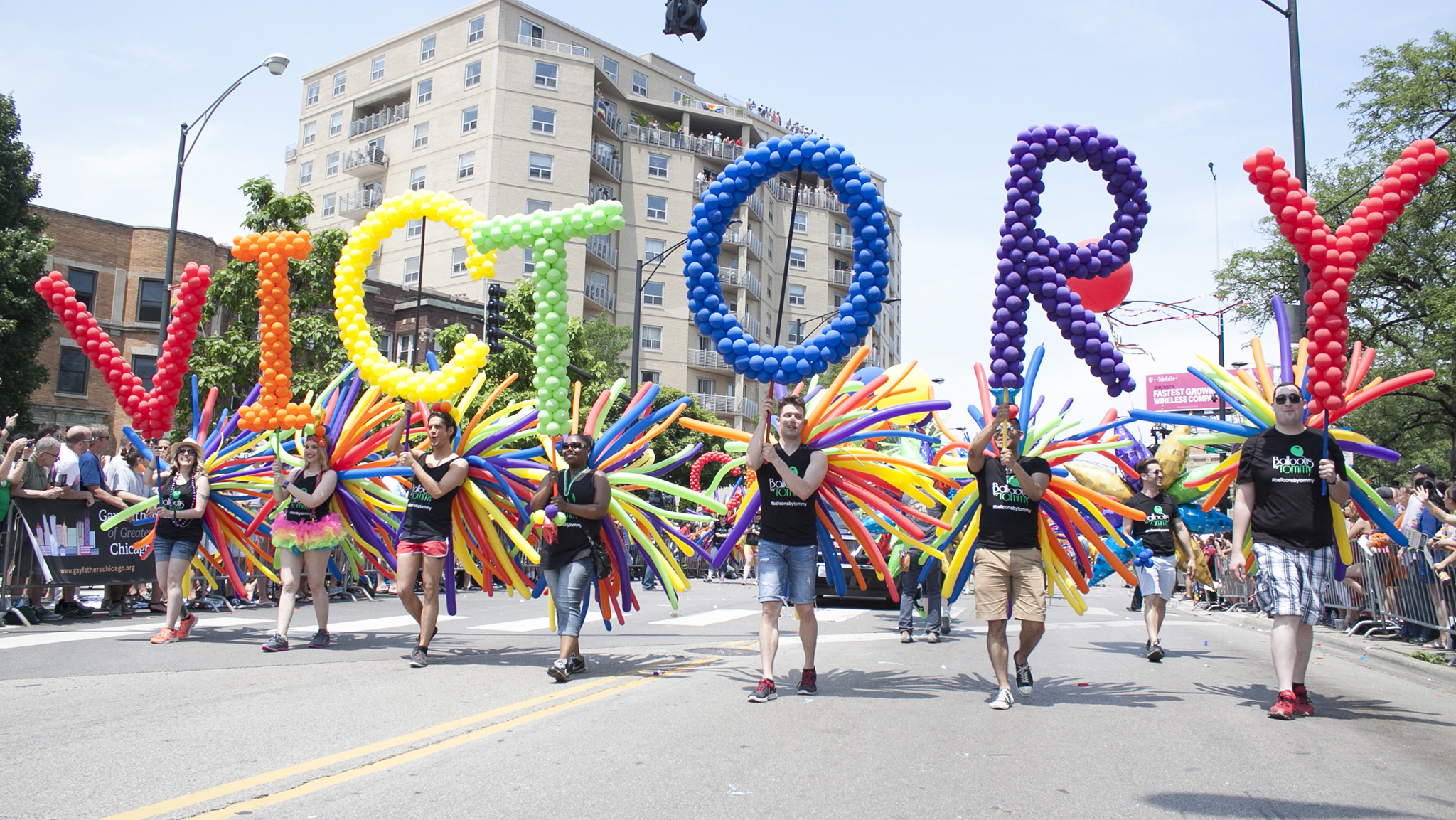
This tug of war is how I ended up crying by Lake Michigan in a blue wig yesterday afternoon. I was at the Milwaukee Pridefest, having done my best to stand out to fit into this colorful crowd I wanted to desperately to belong to.

Despite my efforts at fitting in, I didn’t feel like I belonged. Instead of belonging, I felt shame. Shame that said that the blue wig and eyeliner couldn’t cover up that the person underneath of them wasn’t worthy of being there.

This has become all too common. I feel like I came out too late and am now an unwelcome, uninvited guest to the big queer party. Everyone else seems to know what they’re doing, like they’re all in on something I’ve missed out on something.

And I know that just as my blue wig was in part a superficial effort to mimic deeply felt belonging, this logic of lateness is a superficial manifestation of deeply felt shame and otherness.

Sometimes it’s felt like it would be easier to retreat back to Evangelicalism, faking an “ex-gay” conversion to straightness or celibacy, because I know that world. And sometimes I feel the god of my past murmuring in my soul that this life I’ve chosen really is a life of sin like I had been taught.

And shame sticks. Shame can’t be absolved by a change in behavior, like guilt. Shame is about more than action. It’s about identity.

I wasn’t taught shame by the “clobber passages,” the few verses in the Bible that specifically mention and condemn some type of same-sex sexual behavior. I was taught shame by a theology that told me that these sins were a direct outpouring of my natural state of worthlessness. I was taught shame when I was told that the root of all sins is pride. On the other end of pride is shame, I was told, and this is where I was told holiness begins.

But sinful pride isn’t the opposite of shame. It’s the opposite of humility. A better word for this now is arrogance.

Pride, as we use it now, is feeling secure in the fact that we are loved. Secure in the fact that we were created with beauty. Secure in the fact that we are a part of a community that has existed in every culture in every nation in every time period, a community that refuses to disappear in a world that tries to make it so.

Rather than arrogance, this makes me feel humility. I’m humbled knowing of the fighters who have gone before me, of the lovers who are around me, of this massive legacy I’m blessed to be a small part of.

My coming out last August was preceded a couple of months before by the Pulse nightclub shooting. I saw the death of people in this community I was secretly a part of, and I knew I needed to claim my belonging.

The past year I've learned at claiming my belonging is not a one-time action but a long-time process. And now I’m at a place where I'm finally working on breaking apart the god of shame that haunts my happiness and letting myself be loved by the God of Pride. Not a pride that tells me I’m more important than anyone else, but the Pride that tells me I’m just as important as everyone else. I’m letting myself be loved by the God who said through Jesus: “Look at the birds of the air; they do not sow or reap or store away in barns, and yet your heavenly Father feeds them. Are you not much more valuable than they?”

I’m looking for a Pride that acts as a precursor to external presentations like blue wigs instead of a mimicry of pride that’s expected to follow these presentations. Instead of a pride that comes from fitting in, I am looking for a Pride that comes from a feeling of belonging.

“Fitting in is about assessing a situation and becoming who you need to be to be accepted,” writes BrenĂ© Brown in her 2010 book The Gifts of Imperfection. “Belonging, on the other hand, doesn’t require us to change who we are; it requires us to be who we are.”

The Pride I’m celebrating this month is clumsy and not yet fully formed. It’s still bound up in shame. In our celebrations of Pride, do we have room for this shame we still carry? Do we have space to shine a light on it and counter it with love? Do we have space to speak belonging to people who may not fit in?

The Pride I’m celebrating this month is being born out of a current struggle.

Maybe that’s what makes it worthy of a parade.


Thursday, March 30, 2017

letter to my 8th grade writing class


Writers of 410,
I want you to know that I’m thinking about what you were saying in class today and am taking it to heart. Your thoughts and your words are powerful. Remember that. They are even more powerful when you send them out for others to read or gaze at or listen to or dance to. The world needs the messages you have to send.
Many of you expressed feelings of rejection, betrayal, and anger towards the school and many of the adults in the building. When you expressed those feelings I felt heartbroken, and I wonder if in any way I have let you down and how I can do better by you.
I think I said last week that my favorite book series is A Series of Unfortunate Events by Lemony Snicket. These books echo the ways that children are let down and put into danger by the greed, selfishness, and neglect of adults in their lives. In the second book, Snicket writes of a man named Mr. Poe: 
He was kindhearted, but it is not enough in this world to be kindhearted, especially if you are responsible for keeping children out of danger.
I’d like to think of myself as kindhearted and well intentioned, but those traits can’t keep you from the violence in our world. I can’t stop the violence of these systems that are so much bigger than me and I can’t stop the violence that people inflict on each other.
My hope for this class is that by talking and writing and learning together, we can make a space for each other where, maybe just for one hour a day, we are safe from violence.
I asked to teach this writing class. Even though I am a first year teacher, even though I’ve never been taught how to teach a writing class, I wanted to, because I see this incredible, giant potential in all of you. I see your potential to make a safe space in this classroom that can spread to other classrooms and even to other buildings when you move onto high school next year. I am so, so sorry that you feel like the adults in this building don’t want to be here for you. I am here for you, and I chose to be.
When we were discussing and writing together last week, I felt so hopeful and excited. I’ve been happily spending my free time dreaming what we could do: a field trip to the Museum of Mexican Art in Pilsen to view an exhibit put together by youth; surveying the students and teachers at Otis to come up with ways to improve our school; a publication of written works to share with friends, family, and other writers in the building. 
But this week has been different. This week been frustrating for me. When you talk over each other and over me, when you insult each other and me, when you throw the clipboards and notebooks I spent my own money on at each other, I feel disrespected and hurt. I don’t feel disrespected as an authority figure as much as I feel disrespected as a fellow learner and thinker and writer and individual in this classroom with you. 
The fact that I have good intentions, on its own, is not enough to stop you from feeling angry. And that isn’t my goal. I see your anger, I hear that you feel rejected, and I understand that I can’t or shouldn’t make that go away. 
But if we come together, if we learn to respect each other when we speak and listen, we can use our feelings of anger and rejection and turn them into something powerful. If we honor the shared agreements we came up with and signed, we can stop the emotional and physical violence of the world from coming into this classroom and create a positive space that will spread outward.
But we need to work together. It shouldn’t just be my ideas running the class. Please take time to write ideas or suggestions of things that we can do, things that I can do, to make school a safer place for you. I really, truly want to take your thoughts and feelings into consideration, and I hope that by doing so I can help you feel respected and valued. 
Thank you,
Mr. E

Sunday, August 28, 2016

notes on the down days

Last night there was a moment that was essentially the sad scene in a rom com (minus the relationship issues, which of course is the important part of sad scenes in rom coms). Both of my roommates were out, one at a birthday dinner and one on a date. My partner is in LA for a few days, so I was waiting to hear back from a couple of different friends with potential plans. I had the lights dim and candles lit, a baggy sweatshirt with the hood up, eating pizza rolls for dinner, playing the Bon Iver Pandora station over my roommate's giant Bluetooth speaker.

Without something planned and something productive to do (although I'm sure I could have found something), I felt unsure of what to do and my feelings added up to a sum total of something like bogged down. I tried reading, and I did read, but was more unfocused than usual, not so much attending to other distractions but being unable to attend at all. I sent a snapchat of the scene, maybe as a subtle call for help but also not wanting anyone to respond because that would mean I'd have to communicate.

And it felt strange, and I thought about how long it's been since I haven't had some kind of plans on a weekend night, or on a night in general. No schoolwork, no work work, no money to go anywhere because I'm still not getting my first paycheck for 3 weeks and am stretched thin.

Of course at one time this was normal. This felt very much like most of the weekend nights of my first three years of college, before I knew myself enough to really do anything and when I was too scared of finding out who I was to try. College presented hundreds of  opportunities (that most people don't have the chance to participate in) to engage in all sorts of things I had been taught to fear. I think frequently about how I wish I would have been involved with Pride, or service trips, or theater groups on campus, but those things to varying degrees carried too much danger because they weren't housed under a Christian organization. I had been told and really believed that anything beyond that was the beginning of a dangerous path. As I sat eating my pizza rolls and thinking about how familiar nights like these once were, it made perfect sense to me why I went to a counselor for depression off and on in school.

The past 2 years have been a different world of being off campus, adventuring in a different location every 4-6 months due to my university's elongated period of pre-student teaching placements, a period that was elongated even further by an additional year because I had to retake a semester that is only offered in the fall. In these nomadic years I found myself through blog posts and alone time and by being away from all of the different voices telling me who I was without my permission.

And so I'm still very slowly learning who I am and how to be in the world as that person, how to make a Saturday night productive and meaningful, how to engage with people and not feel painfully awkward the entire time, how to read books, play piano, write, do these things that were slowly shut down in those years that I slowly shut everything down because everything held a potential for damnation.

Last night was too cliche in its dolefulness, but I've been feeling that feeling come back slowly the past few days. And it comes and goes, and some days I take care of myself by going to the gym or calling old friends and some days I eat pizza rolls by myself to candlelight. Some days I spend time with people because I want to and enjoy the conversation and other days I spend time with people because I know I need to even if I can't seem to remember how to talk to them.

The important thing in these down days is to remember that there are up days too, and that one is coming, and that until then we do the little things we can to bring ourselves around. I changed the music from Bon Iver to Janelle Monae, finalized plans with a friend, put on something nicer, painted my nails and scrubbed them off immediately because they were a mess, poured myself orange juice instead of beer, attempted to make my brain work enough to read a few pages, and accepted that at that moment that was the best I could do, and reminded myself that most of the time I'm doing much better these days than I was a few years ago and that I'll be doing better again soon.


Tuesday, August 23, 2016

queer


A little over a week ago I got off the phone with my somewhat-long-distance partner after we decided to "make it official." At one point in time you'd give a partner your letterman jacket or your class ring. Not being sporty enough or blingy enough in high school to have either, and not being from the right era for that to effectively communicate a romantic relationship, I knew I'd have to settle for the 21st-century option.

I texted him about an hour later: "You know this is going on facebook, right?"

"I was about to say I expected you to do it while we were still on the phone."

At least he knew he was dating a social media addict.

Although I've been out to my friends and to any acquaintances I happened to mention it to for a couple of years, many people who I hadn't spoken to in a while, or with whom I had networked with professionally, and certainly the majority of the people I grew up around didn't know I was queer (suspicions aside).

My only direct mention of queerness on facebook prior to this point (that I can remember) was in response to the Pulse massacre in Orlando. I was living at my parents' house at the time in short period between graduation and moving into my next apartment. The morning after the shooting, I was sitting in my parents' small rural church and my dad got up to prayers and announcements.

"And finally, please keep the families of the victims of the shooting in Orlando last night in your prayers."

I hadn't heard about this yet so I took out my phone. Googled "Orlando." Saw the pictures, images, headlines, tweets.

23 dead. Gay club. SWAT team. Dancing. Gunshots. Terrorist. Not a terrorist. LGBT community. Latinx. Thoughts and prayers. Bodies being carried out. Update: 50 dead. Families. Tears. Blood. Can't donate. Please donate. Fuck your thoughts and prayers. Queer.

This moment was strange but not new: sitting in a white evangelical church--a familiar, well-intentioned environment I had been accustomed to growing up--while learning about another world I knew I was also a part of through the electric glow of a screen. I held back tears as we sang a song I had never heard before:

Bind us together, Lord
Bind us together with love 

There wasn't anything I wanted more than to be bound up as one with the beautiful people softly singing around me, but I knew that this wasn't possible as things were. I knew I couldn't be united with anyone from whom I actively hid my membership in this other world where the price of love was blood. And even then, if they knew, would they have loved on and healed these queer wounds, or would they have left me on the side of the road?

At some point in the last week I was accused by a family member of slowly driving a wedge between myself and my family. And true, in high school and college I became more and more withdrawn, struggling to converse or share anything of importance with my family. What I wish they knew was that this was never intentional, that I fought against it, but any conversation too real or disclosure to deep may have contained enough truth to reveal that I was something I had been taught to fear. This may have placed a barrier between myself and my family, but it was a result of the barriers I had carefully placed within myself. Jagged pieces of whatever I could find to make sure that no one, even myself, knew that I was queer. I couldn't just block of dating men, as if that one desire could have been put in a separate box and forgotten about in a corner. With straight people we take it for granted that the desire for romantic love and intimacy infuses itself into every part of life beginning in puberty. For queer folks, this desire is boiled down to sex.

As I've come out to more and more people over the years, I've found myself doing things like reading and writing more, things I once loved but had stopped almost completely, and I never understood why. Leave it to American Horror Story to tell me something about myself. Liz Taylor, the show's first transgender character, was asked why she read after she publicly transitioned and not before.

"I don't think you can shut down one part of yourself without shutting down everything else."

My queer wounds didn't draw blood, but they were (and are) definitely real.

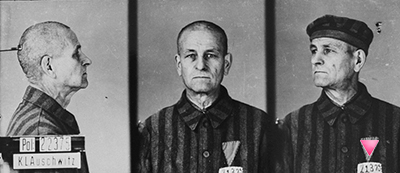
This is why I am using the word queer. This word emerged out of a few different languages hundreds of years ago, with roots as benign as "off-center" and as stigmatized as "grotesque." It was only applied to LGBT communities relatively recently as a term of abuse, but was then reclaimed in the 80's and 90's because really, it fits. We are grotesque to the world. We are off center from the systems that regulate gender and sexuality at the expense of free souls. The symbol claimed during this era of queer activism was a pink triangle, the symbol placed on people identified as homosexuals by Nazis during the Holocaust. Queer claims this history of endured violence.


If you want to know very simply, I identify as gay (with a side of genderqueer, which I'm still figuring out). I usually use this gay my everyday life, because I don't have time to rattle off a blog post every time someone asks me to explain my word choice further. But I prefer queer. Gay is a sexual orientation. Queer is a political orientation.

An identification of queer, as I define it, says more about the world than it does about me. The fact that I am off center from these systems shows there's a problem with the systems. The fact that people find me grotesque shows there's a problem with the world that taught them.

The fact the world has and does abuse the beautiful souls that claim this word shows that it's better to be out of line from it, better to be detestable to it, because it has to be pretty fucked up to come after heavenly bodies like us.

Queer is about deconstructing this world to make way for new ones that still have yet to be imagined. It is imagining, rebuilding, protecting and cultivating the seeds within each of us and seeing what grows. As put by Rinaldo Walcott, it is "the unthought of what might be thinkable." It is a constant cycle of laying down what is old and decaying and resurrecting what is new, taking barriers and pain and blood and turning them into something that dazzles.

And that's what I knew had to happen when I saw that flurry of headlines following the Pulse massacre. I knew, somehow soon, I needed to take down any walls between my queerness and the world. Because the world needs it. It needs to see love--both love of self and of others--take forms it isn't expected to. I don't know what my seed of love can do, but who am I to stop it from growing?

Monday, March 28, 2016

gender without borders

This was originally posted on the Young Teachers Collective blog.


“Mr. E, when are you going to cut your hair?”
A student of mine in seventh grade looked at me, half laughing, half not, not meaning to make a joke but just asking an honest question.
“What?” I said, returning his half laugh and pushing my bangs back. “I like my hair.”
In an attempt to have long hair (because, well, why not?) I haven’t cut my hair since August. The light brown mop on my head has finally grown past what I’ve dubbed the Awkward Middle-Length Period to the Okay-Looking Middle-Length Period. But even though my hair isn’t yet long enough to be pulled back, it’s still too long to fit into my student’s image of what a male teacher should look like.
“When I first met you, I wasn’t sure if you were a girl or a boy because of your voice,” he said a different day during a reading lesson, maybe a bit too comfortable with me and a bit too unfamiliar with social boundaries. I was amused rather than offended—as if being perceived without gender is offensive—and understood why he might have been confused. I am a student teacher in a resource room for students with visual impairments, and my ambiguous-sounding voice coming from an ambiguous-looking blur from the other side of the room on my first day probably would have told him little to nothing about my gender.
I was reading The Bridge to Terabithia with that group of students, three boys in seventh and eighth grade. We had read about when the protagonist, Jesse, meets the other main character, Leslie. “He couldn’t honestly tell whether it was a girl or a boy,” the book says. We were making connections, and this student came up with my initially mysterious gender identity.
“There’s a student at this school who looks like a girl,” another student said, “but it has short hair and uses the boy’s bathroom. Is it a boy or a girl?” I knew of the student in question because all of the staff had been required to attend a professional development session put on by the Illinois Safe School Alliance to ensure that we would be able to support this student, who had recently come out as transgender.
After a conversation on pronouns and clarifying that we never call a person “it” and that “they” is an appropriate pronoun when we are unsure of someone’s gender, I said, “Well, if a person uses a boy’s bathroom, they probably want to be called ‘he.’ He would know what his gender is better than anyone else, right?”
This was the first of many conversations in which we used The Bridge to Terabithia to problematize gender. Jesse’s father is distant because of Jesse’s love for drawing, which he claims will turn his son into a “faggot” (the word isn’t directly stated, but strongly implied). Leslie is the first and only girl to run in the races at school and wins every time. Jesse feels unfit to be the “king of Terabithia” because he fears the rising creek and Leslie doesn’t. Leslie is forced to wear a dress for the only time in the book when she goes to church with Jesse’s family. The two are best friends and more, but their partnership isn’t romantic or sexual. For 1977, this widely-read novel queers gender more than it’s given credit for.
When Leslie joins Jesse’s family for church on Easter Sunday, she gets into an argument with Jesse and his sister about the story of Jesus’ crucifixion. Leslie, who had never been to church or read the Bible, thinks it’s beautiful. Jesse and his sister, who are required to go and believe what they are told, think it’s disgusting. Leslie sums up the situation this way: “It’s crazy, isn’t it? You have to believe it, but you hate it. I don’t have to believe it, and I think it’s beautiful.”
“When you have to do something, like Jesse and his sister had to believe the Bible, does that make it better or worse?” I posed this question to my students, who all agreed that doing something because you have to makes that thing worse. We went on to discuss Leslie and Jesse’s differing experiences with their families’ relationships to their gender: Leslie felt free to wear pants and run with her family while Jesse felt suffocated by his because his passions were too girly. While my students didn’t come to understand or even explicitly learn about transgender and non-conforming gender identities, they engaged with this idea that they are told what that they can and cannot do certain things because they are boys, which means they are not totally free.
This imposition of gender norms is called gender policing, a societal practice that has been fought by feminist movements, queer movements, and countless other movements and groups that have gone by other names throughout history. And it is having an effect on our students. Research by Maria do Mar Pereira, among others (discussed here by Tara Culp-Ressler) shows that gender policing among students in a school setting causes them to restrict and modify their behaviors in harmful ways. This study also found that a slow breakdown of this process leads to more positive behaviors in the school and in the home. Further research shows that heightened gender policing in childhood increases the risk of mental health concerns in adulthood. This is true for straight and cisgender students—those whose gender identity consistently aligns with the gender they were assigned at birth—but even more so for LGBT students and particularly transgender students. The 2013 National School Climate Survey conducted by the Gay, Straight, and Lesbian Education Network (GLSEN) reported that transgender students:
  • Were more than three times as likely to have missed school in the past month (58.6% vs. 18.2%)
  • Had lower GPAs than students who were less often harassed (2.9 vs. 3.3)
  • Were twice as likely to report that they did not plan to pursue any post-secondary education (e.g., college or trade school; 8.2% vs. 4.2%)
  • Had higher levels of depression and lower levels of self-esteem.
The most horrifying statistic comes from the Youth Suicide Prevention Program, which has found that more than 50% of transgender individuals will attempt suicide before they turn 20 years old.
The students I predominantly work with—students of color with disabilities—are subjected to stricter gender policing than white and/or able-bodied students. Whiteness places tighter gender roles on people of color than are imposed on whites while ableist paternalism robs people with disabilities of their self-determination, including (but not limited to) their self-determination in regards to gender. These students are constantly used by those in power as tools for political gain. Because they are already politicized against their will, they must be enabled to take control of their own politics. But how can they control their politics if they are not able to control their gender, or even their hair?
My goal in these conversations is not to “make transgender students” as a friend of mine joked when we discussed them. My goal is to create a space for my students where they feel safe to question what they have been told about their genders and to express their genders as authentically as possible, whether or not their gender identities and expressions align with societal expectations. In other conversations they question what they have been told about their abilities, about their bodies, about their skin, their hair, all of these characteristics that society uses to label them as less.
This is much of the power we have as teachers: we can continue to label and box our students in or we can let them choose their own labels and draw their own borders. The outlines they draw for themselves may be as boxy or boyish or girly as they had been told before, or they may take a different shape, changing shapes, blurry shapes with ambiguous voices and flippy hair that they didn’t know could fit together before. We can aid our students in this process by explicitly teaching about transgender identities, gently queering classic pieces of literature, or taking gendered practices out of our classroom. But maybe the first step for us as teachers is to let ourselves draw our own boundaries, have our own voices, our own hair. When we embrace these aspects of ourselves as equal, our students will feel more and more comfortable doing the same. And as more and more youth embrace all aspects of themselves as equal, the world will be more and more free.

Tuesday, January 12, 2016

little epiphanies


I have recently been learning more about the church calendar, which my life has seemed to be naturally following as of late. I wrote in December about my longing for individual and global justice in Advent and my experience of the hope of Christmas with my students. Advent was also marked with anticipation of my long-awaited move to Chicago which came to be at the end of the Christmas season.

And now we are a week into Epiphany, the season inspired by events in Jesus's life such as the arrival of the magi (the "wise men from the East"), the turning of water into wine, and the Transfiguration. These are moments of realization and celebration of the identity of Jesus breaking into the everyday.

In the Gospels these realizations are often made by outsiders and celebrated in ways that are no more conventional. The magi celebrate it wastefully by bringing gifts too extravagant for a child. Jesus himself celebrates it scandalously with too much wine for a party. And Peter celebrates it awkwardly with a proposal to live in tents on the mountaintop so he never has to go back down.

Of course we do have to come back down from moments where the reality of Jesus is unavoidably clear to the lows of everyday humanity where he is harder to find. But whether we are in places high or low, Jesus is here. He's here in our heartbreak, our doubts, our insecurities, our limits, our fears, our blood, our awkward moments, our strained relationships, our regrets, our longing, our anxiety. He's here in our poverty, our oppression, our marginalization, when we're forsaken, rejected, alone.

I don't know what that always looks like or even why that's always a good thing. Sometimes I wonder, "Jesus, why would you come here? Why would you come here as a baby? I thought you were coming as king!" But at the very heart of Epiphany is the truth that in his infancy Jesus was the king, a truth declared by the magi in the courts of King Herod himself. "They delegitimize the very power structure of Roman-occupied Judea," writes Ben Irwin. "The magi arrive at Herod’s palace and ask for his help locating 'the king of the Jews.' No wonder he was mad."

It is nothing short of divine to realize that God is found with a child and not with Herod, with the poor and not with the rich, with students in under resourced schools and not politicians. And though the latter violate the former by killing them, by demonizing them, and by depriving them of resources, God is found not in the security of the oppressors that is sustained by such violations but rather in the joy of those who are joyful in spite of them.

In Epiphany we focus on the truth that Jesus grew up with us, cried with us, laughed with us, died with us. He lives with us, so we can live with him. The oppressive systems of this world can't claim that, only those of us with bodies and souls can. Out of this victory Paul taunts death itself: "Where, O death, is your victory? Where, O death, is your sting?"

As in the Gospels, these realizations and celebrations involve unexpected people and happen at unexpected times in unexpected places. They are genuine laughter in periods of mourning, or the presence of someone to mourn with. They are the church I went to on Sunday erupting in cheers at the announcement that a woman is finally done with chemo. They are small gifts that sustain more than the giver could have imagined. They are people tearing holes in buildings so we can all have equal access. Who knows?

Jesus comes like a thief in the night, like a swiftly changing wind, like a baby after birth pangs. He comes when you least expect it, in spite of your preparations, because of your preparations. Always be on the lookout, because you never know when or how or to whom Jesus will appear.

As I settle into this city I've waited so long to be in, I'm going to be looking for Jesus. I hope to write a few more posts during this season of realization, but I hope even more to actually realize when I am in the presence of Jesus, to actually celebrate it, and to actually live out his story. In his book Living the Christian Year, Bobby Gross writes that "Epiphany...is a time to both inhabit the Story and tell the Story, for the in the telling itself we are further enlightened."

Let's go into this cold world where finding evil and injustice can be so easy and focus on finding holiness and righteousness, on finding Jesus, and celebrating all of our little epiphanies.

Monday, December 14, 2015

why I must vote: reflections on Montgomery, Selma, and the winding path to justice

I’ve had the opportunity to go to Alabama with a group of other students from my university. We got to a town outside of Birmingham last night, where we are staying in a church. This morning we drove to Montgomery to see the Southern Poverty Law Center and their Civil Rights Memorial.

The memorial, designed by Maya Lin, consists of a curved wall with a quote from a speech by Martin Luther King, Jr., a paraphrase from Amos 5:24:"...until justice rolls down like waters and righteousness like a mighty stream." In front of the wall is a large inverted cone, the surface flat but off-center, as if it's leaning under the weight of the circular timeline on its surface. The timeline begins with the death of Emmett Till in 1955 and circles around to the death of Martin Luther King, Jr. in 1968, listing a number of others who died in the movement. There is a 2-foot gap between King and Till's names, a space for everyone not mentioned, a space for us who look on, inviting us to choose: "how will you be remembered?"

The Civil Rights Memorial
That afternoon we drove on to Selma, the historic site of what is now known as "Bloody Sunday." In 1965, a large group marched through Selma to fight for the Black vote. When they crossed the Edmund Pettus Bridge, they were met with a militarized police force, which brutally attacked the protesters.

A picture of a group of protesters in front of the Edmund Pettus Bridge, lead by Martin Luther King, Jr.
On the bus ride back to the church, we were given time to reflect in response to a few prompts preparing for our evening discussion. The following two prompts stuck out to me:
Take a moment to “check your privilege.” Think about how not in 2015 most people can vote but many don’t. Why is that? With presidential elections coming up soon do you think you will vote? Has learning about Bloody Sunday altered your decision on voting in any way? 
What is #BlackLivesMatter to you?
Maybe this is bad, but I don’t care that much about voting. Like, I know in many ways, cognitively, that I should. But the prospect itself doesn’t land on me with any weight or leave me with any sense of urgency, but rather just brushes by me, leaving me not with the impression of a great right or responsibility but rather with a soft “meh.”

Right now, my slowly-emerging politics are mainly concerned with challenging the way people think, challenging what is accepted, pushing up lesser-heard narratives and pointing out their nuances when people oversimplify them. I know how to complicate things, to ask questions, not to provide answers. Not to provide solutions. Not to change policy. Not to vote. I often just figure that if people’s hearts and minds are changed, policy eventually will too, a kind of “trickle up” theory of politics.

And I do, in so many ways, believe in that. But I also know that my privilege has left me without the need to worry about policy or political representation. My privilege has left without the need to vote, because change doesn’t need to happen for me. If the world remained exactly how it is, I could go on to lead a successful and fulfilled life, mostly unaware and unconcerned about the fact that my success would come at the expense of others, would be built on the backs of others who have been tracked into the massive system of labor designed to make it look like I worked my way to where I am.

But I’ve already learned too much. Maybe it’d be possible for me to forget or to unlearn, maybe if stopped following half of the people that pop up on my Twitter and Facebook feeds, maybe if I moved to an all-white area and taught all-white students and used a curriculum written by all-white people that sends the message that racism is in the past and everything is, finally, as it should be. Maybe then I could forget that it’s not. And sometimes, I think it’d make things a whole lot easier.

But I don’t want to forget, and at this point, I don’t know if forgetting is possible. Maybe living in denial would be possible, but not outright erasure. Today I stood on the bridge in Selma where people gave their bodies for the right to vote, stood in front of the Civil Rights Memorial, in front of the gap in the lopsided, circular timeline that wobbles and rolls and circles round and round “until justice rolls down like waters,” and it left me with the choice of stepping into that gap in the timeline that bends towards justice or of opting for one more steady, one where change is an annoying occasional jolt to what I’ve accepted as normal rather than a leap towards an elusive future I am working towards because I refuse to accept the world we’ve been given. I stand there, a body marked with a free pass out of this uncertain loop barreling forward, and I feel—even though the choice is my own—I feel no choice in stepping in and rolling onward, hoping that the 120 pounds that my slight frame adds to this motion can help to build some momentum, help to continue the movement towards a world that embodies mysterious words like glory, love, and justice.

The group from my university in front of the Civil Rights Memorial
So, as I go forward, I know I must vote. Because as much as this act may hit me with no more force than a puff of smoke and as much as my participation may hit others even less, I know it’s not just for me. If voting doesn’t increase my own security or representation—as if I need more of either—if voting isn’t for me, then it must be for people like Laquan McDonald, Sandra Bland, Tamir Rice, Rekia Boya, Eric Garner, Michael Brown, Emmett Till, Malcolm X, Martin Luther King, Jr., all those who have been killed by injustice and resurrected through retellings of history, through marches, through hashtags, through this movement that demands that I act like their lives and their deaths matter, that their destroyed bodies matter, and that—even though they carry little weight—my vote and my body and the things I do with them do, in fact, matter.

Thursday, December 10, 2015

advent at the Illinois School for the Visually Impaired

A couple of days ago I took down the Christmas lights I had up in my room. Maybe a little strange for two weeks before the holiday, but it's not because I've suddenly lost my Christmas spirit. Really, before today I wasn't quite in the Christmas spirit yet. No, the lights were just decorative mood lighting in the room I stayed in for the semester at the Illinois School for the Visually Impaired, where I taught the last seven weeks. They came down with everything else I had hanging on my walls, like quotes scrawled out on pieces of paper or a giant poster of Peter Pan. I don't wanna grow up either, Peter, I thought.

For the record, I didn't actually think this. I'm not that melodramatic. But it fits, right? Part of growing up is constant change, of too many goodbyes, and the last year-and-a-half has already had enough of those. Last fall I lived in Indianapolis for six weeks, followed by a year-long tour of Illinois including Jacksonville, Freeport, Normal, Chicago, and then back in Jacksonville this past August. The moves have all been for school, moving from one teaching placement to another in a longer-than-usual-due-to-complications pre-student teaching phase. 

And I'm finally here. Finally packing everything into my little car for the last time before moving to Chicago to student teach (and then, hopefully, teach). I was supposed to be here a year ago when it was suddenly delayed. After a year of learning more about urban education, networking with Chicagoans through social media and a summer internship, and going through four different clinical placements, I feel more than ready. This is a gift I've been waiting for most of my college career, and I'm grateful for everyone who's invested in it.

So why hasn't it felt like Christmas?

While the last year has been the most life-giving year I've had on a personal level, it has been a year full of pain and discord on national and global levels, and I've found it harder and harder to disconnect myself from it. The anti-blackness that had become a national focus in the fall of 2014 has continued. Racism against Mexicans and other Latino populations has been given political backing by the consistent top pick for the republican presidential nomination, who has also triumphed Islamaphobia by proposing to block all Muslims from entering the country. Xenophobia has become rampant as we've barred Syrians from seeking refuge in the states. And gun violence has appeared in headlines for multiple shootings, most notably those at a Planned Parenthood clinic and a home for adults with developmental disabilities. This violence even hit in my own community last week when a woman was shot by her husband, both of whom I went to church with years ago.

If this world and this awareness of it are the gifts of adulthood, then no, I don't wanna grow up. 

No, it hasn't felt like Christmas to me. But it has felt like Advent, this period of anticipation of and longing for the coming of the incarnate Christ. This is more than putting up decorations or getting your shopping done. The Biblical anticipation of the Messiah "was in the context of oppression and injustice," a "groaning of creation" for the coming of the Creator, "the Word made flesh." Yes, I'm anticipating my indefinite move to Chicago and the purpose and relative stability that will bring. But I'm also anticipating healing and hope for a broken world that so desperately needs them.

And of course, like anywhere else, this school I've been at needs them, too.

The "goodbye" cards I made for my students.
They say "It's been so much fun teaching you, I'm going to miss you! - Mr. E."
in braille on one side and large print on the other. 
This morning we all made our way into the auditorium to see a nearby high school choir perform Christmas songs for us, as they have for the past several years. After they finished and filed out of the auditorium, the principal stood up front. "Since we have you all in here, I wanted to talk to you about something," she said. "Most of you have probably heard that we lost someone very special this week." Most of us heard yesterday that one of the aides had unexpectedly died of a stroke the night before. I had never met her or Nick (all of the names in this post have been changed), the student she had worked with for almost 15 years. "It's okay to be sad. It's okay if you didn't know who she was, and it's okay to still feel sad if you didn't know who she was."

"Did she go to be with Jesus?" a student asked.
"Yes, she went to be with Jesus," the principal responded.
"Is that why Nick isn't in school?" another asked.
"Yes, he was with her every day at school since he was 3," the principal said, trying to hide the quiver in her voice. "He's feeling very sad right now. He will be back in school once we find him a new aide and once he feels comfortable being here."
"We need to find Nick a new aide!" a small voice from a small first grader in the front row squeaked out, "Can Mrs. Thompson do it?" he said, referring to another administrator at the school.
We all let out teary laughter. "I'm sure she would love to do it," the principal said.

And this is what I have loved most about teaching at this school. Not witnessing my students "overcome" their disabilities, as is the popular narrative in the media. We prefer to view people with disabilities through our American lens, turning them into the ultimate "rugged individuals." While I love seeing my students grow in independence and face new challenges, these gains are always within the context of interdependence. These kids constantly think of each other, constantly look out for each other, constantly seek to make sure that everyone is being accommodated for and included. For the most part. There is still bullying and drama like every other school because these kids are still kids. People with disabilities are not psuedo-angelic, hyper-moralistic beings. They are people. But their limitations and the ways they are left out by society can, if it is fostered, make them more aware of the limitations of others and more intentional in their efforts to accommodate those contingencies. This interdependence is not something to be "overcome" but to be celebrated.

Once everyone's questions were answered, the music teacher spoke up. "Megan, can you play us something on the piano?" A high school student made her way to the piano at the front. "Do you know 'Amazing Grace?'" And she began playing. She played a short intro, and then the room full of students and staff began quietly singing along. 

"Amazing grace, how sweet the sound..."

An aide behind me started sobbing.

"...that saved a wretch like me..."

A teacher moved up a row and put her arm around a student who was crying.

"...I was once lost, but now I'm found..."

Several students put their hands on the back of another student who was crying.

"...was blind, but now I see..."

These students are blind, but they can see more than many of us can.

She went on to play two more verses, and then we stayed in the auditorium and sang Christmas songs together until it was time for lunch. We laughed and cried and clapped and sang, enjoying our time together after being reminded why enjoying our time together is so important. "Do you know 'Friends are Friends Forever?'" a student asked. The student at the piano did--apparently they sing this every year at graduation--and we all sang and cried and rocked together in gushy 80's cheesiness. 

And that, all of that, all of that, that's Christmas. I mean, that's Jesus, right? God bursting into our wounds and our weaknesses and our low places, somehow bringing joy and healing. Even when we are in need, especially when we are in need, the joy of Jesus can be found. "Now I know in part; then I shall know fully, even as I am fully known. And now these three remain: faith, hope and love. But the greatest of these is love." The love these kids show each other when they are in need, the love that recognizes they are always in need because we are all always in need, is the love of the incarnate Jesus, the love that comes into what is broken, what is needy, what is incomplete. And "when completeness comes, what is in part disappears."

This Christmas season, I anticipate both my move to Chicago and the love and justice of Jesus in our world. But I have a feeling that I've already seen that love and justice here. If only the whole world could have sung "Amazing Grace" in that auditorium with those kids, maybe there would be a lot less problems. Or maybe not. Part of growing up is knowing that singing a song together won't change the world by itself, although I'd like to think it can start to.

As we headed out of the auditorium, I finally felt like it was time for Christmas.

Tuesday, December 1, 2015

a sea of glass

In recent years, I’ve decided that a faith that comes easily to you isn’t worth keeping. If I told you that I was born into a strong Evangelical Christian home to two loving parents, who had both been born into strong Christian two-parent households, you may think my faith came easily to me. And maybe it did. My very name, Elijah, means “YAHWEH is my God.” Even my birth certificate contains a proclamation of faith.

This faith and this family was a happy one, for the most part. The Earth I was born into was created in 6 24-hour days, carefully documented in the first paragraphs of the Bible. This book, I was told, was God’s love letter to me, the only source of truth, the literal Word of God written through the personalities of several inspired authors. “The B-I-B-L-E, yes that’s the book for me!” I sang in preschool. I began helping with Cubbies, a weekly preschool program at our church, when I was in seventh grade. “I stand on the word, the word of God, the B-I-B-L-E. BIBLE!” I would sing along with the preschoolers. Years later I was the song leader at my grandparents’ church’s Vacation Bible School. The material that year was from Answers in Genesis, an organization that strongly asserts a literal understanding of the Bible, particularly the first 11 chapters of Genesis. “The Bible says it, that settles it. Simple as that!” I sang in front of 30 children under the age of 12. But at 19, that claim didn’t seem so simple.

The VBS at my grandparents’ church was an annual tradition, a time my cousins and I got to spend a week together without our parents around. It’s my cousin Sam—an only child—Trent and Brianna—brother and sister—and my little sister and me. When we weren’t at VBS we focused our time on an assortment of games and adventures. Our grandparents built their house on a large property in the country that’s surrounded by a line of trees and filled with a large pond amidst rolling wheat fields, a small paradise as idyllic as our view of the world. We ran for long hours under the hot sun around the pond, darting in and out of the trees and around our grandpa’s plots of corns and beans. We looked up from the deck or from blankets or from the paddleboat many nights at the expanse of stars that crowded into our sky to show off for us. Various forms of wildlife were hidden in the pond and in the hills and grasses in and around my grandparents’ farm. The pond teamed with catfish and ducks, and we would swim and fish and imitate the duck’s calls from the small dock. During the day we would stop in hushed awe whenever we spotted a deer, trying to keep our presence unknown. At night we could hear coyotes howling, close enough to excite us but not to scare us. And of course at the center of all of this was our grandpa and grandma, both strong and wise and wonderful in their own ways. It’s easy to be there and understand why God called his creation good.

Our questions and our explorations had always either been of fantasy or within this set reality, a reality that itself remained unquestioned. That is, until Answers in Genesis. “Do you guys really think it happened like this?” someone said. I don’t know who the instigator was, but all it took was one question for this program that was meant to breed certainty to begin breeding discussions of doubt. “Do you really think the Earth is 6000 years old?” “Do you really think dinosaurs lived alongside humans?” “Do you really think all of these scientists are wrong?”

"The Great Unknown" from The End by Lemony Snicket, drawn by Brett Helquist
“The Great Unknown” is personified, somewhat, in Lemony Snicket’s A Series of Unfortunate Events into a large question-mark-shaped sea creature that in The End approaches a group of characters. “In an instant they were gone,” we are told, “either swallowed up or rescued by that mysterious thing.” That’s how that week feels in my memory. Although each of us had been on individual journeys of deconstruction before that point, it was the first time any of us voiced our questions. And, no less, they were voiced in the very center of our young universe. The four of us and our universe suddenly felt much older than before we’d ever thought to question its age. “In an instant” that universe was gone, “either swallowed up or rescued by that mysterious thing,” and it felt like we went with it.

As a 13-year-old immersed in the all-encompassing world of Evangelicalism for Teens!™, my sister was too young for this odd week of too many Questions in Genesis and not enough Answers to have a lasting effect. But the rest of us were disconnected enough from that culture and had already questioned enough for this week to pull us further down a slippery slope with few footholds. The four of us have since been on our own journeys of losing and, every once in a while, finding our faith. These journeys are separate but similar, intersecting for holidays and our annual summer Cousin Week, which no longer includes VBS. Our time together is now spent on these big questions. We stopped talking about our fantasies that year. Learning and unlearning reality has proven to be enough.

In the creation myth of Genesis, the water on the Earth is separated from a layer of water in the sky by something called “the firmament,” an invisible dome placed high above the Earth. Many literal Biblical creationists believe the firmament broke during the Flood, providing the excess of water that covered the Earth in a drowning only Noah and those in his ark could survive. I was held under my own firmament of sorts, a carefully-constructed systematic theology meant to protect me from the chaos outside.

A depiction of the firmament
Ta Nehisi Coates writes that all of this chaos, “the sociology, the history, the economics, the graphs, the charts, the regressions all land, with great violence, upon the body.” Coates is of course talking about racism, an evil that I am not a target of, but the hatred of my queer sexuality brought a different form of violence upon my body. Queer theorist Elizabeth Grosz asserts that “the body is what it is capable of doing,” and while I don’t agree with that fully, I think I do believe that the body cannot be split from the things it does and desires to do that are life-giving. You cannot exist fully, in the open, without shame, before a god that tells you your sexuality is beyond redemption. “It is this split,” Grosz writes, “between what one is and what one does that produces the very possibility of a notion like ‘the closet.’” The firmament was my closet, keeping my sexual orientation pushed out of everyone’s view, including (as much as possible) my own.

The VBS that year had been only one occurrence among many that chipped away at the firmament until it broke and water and shards rained down and cut me to my core. My closet, my safe-haven, the gilded cage I called home was transformed from a still peace lingering above me to a crashing force coursing through me. I was unprotected, but instead of feeling hit by reality, I felt hit by the lack of it. The weight of nothing weighed down from above and within me, the dome compressed into a singularity at my center, and I was slowly sucked inward. As the pieces of my faux heaven were crunched together with the pieces of my avoided self, the only reality that formed was that of a sexuality and thus a body and personhood that were unwelcome in throneroom of God. I hadn’t done anything, but the distinction between being queer and acting on my queerness was evidently arbitrary. “Guilt was not my problem as I felt it,” writes Lewis Smeades. “What I felt most was a glob of unworthiness that I could not tie down to any concrete sins I was guilty of. What I needed more than a pardon was a sense that God accepted me, owned me, held me, affirmed me, and would never let me go.”

That summer in 2012 began a two-year dance with darkness. I no longer knew if God existed, or who he was if he did exist. I had feared Hell before, but the fear became ubiquitous to the point of tedium, the adrenaline of terror replaced with hopelessness and impatience for the day my inevitable eternal fate would arrive. The motivation I’d had for school the year before was slowly drained down the rabbit hole inside of me to a land of wonders I no longer had access to. The “once saved always saved” theology of my upbringing all at once seemed patently false.

“Is everything okay?” a professor asked me the spring semester of my junior year of college, a year and a half after Answers in Genesis. I was close to my lowest point. “I’m worried because of your grade on the midterm”—I’d been aware that my emptiness had affected my grades—“but I’ve also just been worried by how you’ve been acting. You seem distracted, like your mind is somewhere else.” I didn’t realize that not only my academic performance had changed, but also my demeanor.

How could I answer her question? I didn’t know how to say that my mind wasn’t on school because it was on thoughts of eternal damnation, or that I was mourning a being I wasn’t sure I existed, or that the only important things I thought I ever knew had been taken away, leaving nothing in return. The foundation of my soul had disintegrated to dust. But as these things go, I simply replied, “I’m fine.”


Looking back depression is an obvious word, but it wasn’t one I thought made sense for me. I equated depression with sadness, and I was not so much sad as hollow. Even my moments of laughter rang into a void that erased their meaning. But when the word was given to me by a counselor a couple of months later, it was more freeing than accusing. I watched a TED talk by Andrew Solomon on depression shortly after and it all clicked. “The opposite of depression is not happiness,” he told me, “but vitality.” More than happiness, I had lost my vitality in the face of the muchness of the nothingness of our existence and the muchness of the queerness of my own.

What I have learned is that the greatest beauty and greatest tragedy of the Christian faith is that God somehow entered into this chaos, this muchness, all of which fell “with great violence, upon the body” of the crucified Christ. In the midst of his torture, Jesus cried out: “Eli, Eli, lema sabachthani?” If he spoke English, he would have said something like “My God, my God, why have you forsaken me?” If he spoke Hawaiian Pidgin, he would have said something like “My God, my God, how come you go way an leave me ova hea?”

“Hey dude!” I was sitting in a circle with other junior highers from my church youth group in a homeless ministry in the inner city of Chicago. The woman in charge was recalling the prayer of someone who had come for a meal. I was struck by the use of such a casual title as “dude” for God. Are you allowed to say that?! seventh-grade me thought. The prayer continued to strike me in its informality: “This sucks!”

The book of Revelations describes a “sea of glass” in the heavenly throneroom. I’ve been told this is meant to represent the peace that comes in the presence of God, peace enough to make a raging sea as still as a pane of glass. And that’s probably what John meant. But I read that and see a sea of glass that’s been shattered, a sea as tumultuous as any, each swirling particle of water replaced with a shard of the world we once thought we knew. And this is the water we’re told we must walk on to get to the throne of God.

“Hey dude,” she recalled the second half of the prayer, “Thanks.”

What, though, is there to be thankful for? My cousin Sam wrote this for Thanksgiving this year: “I am loved, and I am loved above all else by a father who pours out mercy far greater than any torrential downpour” of water or shards “that I may have to endure. Ultimately, this entire symphony of highs and lows will mold together into one single drop. A drop that nourishes, a drop that heals.” Somehow Jesus let himself be severed from his Godship on the throne and instead walks on this sea of glass with us, walks over and through and within the broken firmament with us. “The Spirit that once hovered over the waters had inhabited them,” writes Rachel Held Evans, “Now every drop is holy.” Even as God leaves us “ova hea,” Jesus never does. The reality of his presence in this place promises the reality of his presence beyond this place, far beyond where any firmament could ever reach, and the joy we think we can only find in the muchness of that space can be found in the smallness of our inward temples. “If anyone is willing to enter into my private hell and stay there with me,” writes John J. McNeill, “then there are grounds for hope.”

"Encounter with Christ" by Newton D'souza
I found the Trinitarian God and the dying and rising Jesus not in churches but in the streets of Chicago, where I lived and worked and taught summer school the past two summers. I found him in the bodies of Michael Brown, Rekia Boyd, Eric Garner, Sandra Bland, Tamir Rice. I found him in America’s black and brown bodies and neighborhoods, crucified by Jim Crow’s grandchild, mass incarceration. “The crucifixion of Jesus by the Romans in Jerusalem and the lynching of blacks by whites in the United States are…amazingly similar,” James Cone tells us. “The lynching of black America is taking place in the criminal justice system.” I found him in their little resurrections, in their joy that acts as resistance to the chaos that lands on their bodies with much more violence than it does mine, in the collective resurrection taking place in this movement insisting that, despite the way of things, black lives matter.

I found him in my students, called disabled by a world that believes in the myth of able-bodiedness. I see him in their frustrations, in the truth that is maybe more evident to them that, as put by Nancy Eiesland, “ordinary lives incorporate contingency and disability” and that “disability does not mean incomplete and that difference is not dangerous.” I also found him in their little resurrections, their joys, their resistance, the moments their bodies do not only get “in the way of creativity” but rather become “a conduit for it.” I see the Trinity in their strong sense of individual personhood within a network of trusting interdependence. My sometimes difficult faith has been enhanced by their sometimes difficult lives. “Because a difficult life is more complicated than an easy one,” writes Nancy Mairs, “it offers opportunities for developing a greater range of response to experience: a true generosity of spirit.”

And I found him in queer communities, who live in their bodies with their sexualities before God without shame, as they did in Song of Songs, as Adam and Eve did in Eden before they tried to know good and evil, tempted by a desire to control this wide and varied world. I found him in their continual creation, their taking part in the divine work of deconstructing our superimpositions upon the world and building a growing a more beautiful one. I found him in their love, a communal love that spans borders, bleeding grace into every place and to every person that are told they are not worthy.

These people show me Jesus because, of course, Jesus is not an idea but a person. “While we attempt to figure things out…the truth shows up in the form of a person. While we are sifting through the shards of glass on the floor, Jesus is waiting patiently at the door.” When I first read this statement by John Wilkinson in the fall of 2013, I expected this person of Jesus to show up as some detached experience of feelings, or as a moment of clarity, as a sudden recreation of the firmament. But Jesus comes not to take us away from the reality of existence, but to be with us as we take part in deconstructing what destroys and building up this unpredictable phenomenon we call life. Once firmaments and closets are deconstructed and all of our hidden and queer bits of life are brought into the open and melded into a whole, the process of deconstruction and wholeness—death and resurrection—rolls on.
The view from the back of my grandparents' house
My cousins and I were together last week, having big conversations in our grandparents’ paradise that seems much smaller than it once did, much younger than it once did in comparison to the vast and ancient universe it sits within. It had become less of a paradise, too, somehow tainted by the sad things of the world we never imagined could creep in. Even as our questions floated around our heads and through the branches of our ailing family tree, we found the presence of the Trinitarian God in our solidarity through uncertainty, in this being together even when a world unprotected by firmaments threatens to tear us apart. A speaker I saw once whose name I don’t remember proclaimed that “the foundation of the Gospel is that God is a community.” And here, amid deconstruction and because of it, God is found.

Wednesday, November 25, 2015

intersectional bodies and the hunger for justice

The main reason I started writing this blog last May was to grapple with this trendy word "justice." And quite often, I really still don't know what justice actually is. But I am learning more and more what justice is not.

One thing I know for sure is that justice is for all who need it. Conversely, I know that justice is not justice if it is only given to a few.

This incomplete version of justice has appeared repeatedly throughout history, when we have formed groups that are meant to focus on justice for certain groups of people, and only those groups. By doing so, we leave out many other groups.

When we fight for justice for a certain group of people and talk solely about the form of oppression that group faces as a whole, we ignore other forms of oppression that also work against that group just because they do not work against every person in that group.

This has happened in black liberation movements that--by solely focusing on anti-blackness and not also working against sexism--have been lead by black men and leave out the voices of black women.

This has happened in disability rights movements that--by solely focusing on ableism and not also working against racism--have been lead by white people with disabilities and leave out the voices of people of color with disabilities.

This has happened in feminist movements that--by solely focusing on sexism and not also working against racism--have been lead by white women and leave out the voices of women of color.

These are only three examples. There are numerous forms of oppression, numerous causes, and numerous people who are left out.

The exclusivity of all of these movements only work towards a partial picture of justice not because they exclude people who are white, able-bodied, or male. Insisting that these movements include those who benefit from the oppression they are fighting against doesn't make the justice that flows from the movements more all-encompassing, but less. When we respond to claims to justice for the downtrodden by claiming justice for those on top, we do not expand justice. We stifle it. Justice doesn't need to remember those who have always been present in our collective consciousness. Justice needs to remember those who have been absent. Jesus proclaims "good news to the poor," not to the powerful.

In the case of #BlackLivesMatter, a just response is not to see its exclusivity and say that #AllLivesMatter. A just response to the real exclusivity of the movement has been the hashtag #SayHerName, which brings attention to instances of police brutality against black women in a campaign that has largely focused on violence against black men.

This hashtag addresses intersectionality, the truth that we all hold multiple identities and group memberships, some of which may give us access to privilege while others hit us with oppression. As Audre Lorde famously put it, "There is no such thing as a single-issue struggle because we do not live single-issue lives." We are whole people, and any movement that ignores the multiple forms of oppression faced by individuals leaves them out entirely.

This does not go against the need to specifically name and work against different forms of oppression. To make justice a reality, we must have some level of focus. But this is, of course, why we must always work within community. We may be called to specifically called to work towards justice here, and others there. We are one body with many parts, and each of us has a unique role to play.

But we can never say that we don't need any other part of the body, no matter how weak it appears. "On the contrary, those parts of the body that seem to be weaker are indispensable, and the parts that we think are less honorable we treat with special honor...But God has put the body together, giving greater honor to the parts that lacked it, so that there should be no division in the body, but that its parts should have equal concern for each other. If one part suffers, every part suffers with it; if one part is honored, every part rejoices with it." (1 Corinthians 12:21-23a, 24b-26)

Even if our focus is on one form of oppression, we must always let ourselves be shaped by the other members of this body, particularly those parts we have too often viewed as "less honorable." We cannot let the perceived weakness of certain parts of this body be an excuse to ignore them, because the things we call weak that are truly indispensable. Power is not made perfect in the strong things of this world, but in weakness.

How we respond to our brothers and sisters facing intersectional oppressions will vary. Maybe we are in a place where we can truly act, or maybe we are in a place where the justice work we are already doing is the most we can manage. But at the very least we must suffer with them, honor them, listen to them. Justice is for all who need it, so we must always look for those who are left out and forgotten. Only then will justice really come forward.


Tuesday, November 17, 2015

the drugs of culture wars, social media, and power


Another week, another culture war.

This week my Facebook was filled with thumbnails of the French flag in the wake of multiple attacks by ISIS in Paris, which were followed by criticisms of the eurocentric responses to the attacks, which were then followed by debates about whether or not the government should be allowing Syrian refugees into the country, or how thorough the vetting process should be, and it continues and morphs faster than my basic-phone self can keep up with (I prefer basic phone over "dumb phone," thank you very much). Profile pictures are changed, blogs are written (clearly), hashtags are used, and we all feel a little bit better and a little bit worse for having participated. Sometimes part of us wants the injustice to end just so our online lives return to an elusive peaceful norm and sometimes we want it to spring up again so we can revel in the chaos, drawing battle lines around statuses and making our loyalties known with likes and retweets.

Social media is a drug, and the highs are even higher and lows even lower when a crisis is involved.  Maybe it's because we want to change things, or because we want to make sense of things, and maybe we just want to feel validated. That's not to say that people don't care deeply about justice. Many, many do. But each of us is barely a single person and none of us are quite whole, and our motives and desires are mixed and often mysterious even to the most self-aware. This is all of us, to varying degrees, at different times, in different ways. I believe that the vast majority of people want to see more good and justice in the world, but the world is a messy place and the meanings of goodness and justice are evidently not always self-evident. Justice is a trendy word, almost too trendy to be meaningful.

Despite their issues and ambiguities, modern conceptions of justice and social media crusades should not be left behind. Social media can act as a gathering place for oppressed and scattered voices and has been a powerful vehicle for the nation's biggest movement for racial justice since the Civil Rights Movement. Social media solidifies and amplifies our voice by giving us a platform and a virtual audience. For people who have been denied a platform, this is truly liberating, truly Gospel bringing. When used by those who have less access to other means of social engagement, social media can lift up stories and injustices that may otherwise be ignored and bring glimpses of a kingdom where "the last will be first and the first will be last."

But when this platform becomes the main platform that most people use to engage with social issues, those with power can perceive these echoes of equality as a sign that the roles have actually been reversed. And if you are first, a kingdom where "the last will be first and the first will be last" is not good news for you. The powerful see in these words a reflection of a world where their power will be taken away, and they feel their power must be defended. Statuses and tweets and likes and comments suddenly become infused with importance not because there is power to be gained but because there is power to be lost. This is nothing new; spaces claimed by those experiencing oppression have always been claimed by people who benefit from it,

And then in all of this are us problematic sometimes-white-savior-y people, who have largely been on the receiving end of privilege and see that that's injustice and try to use the increased power we have on this platform to lift up the voices that have been historically pushed down. And I tend to think that's a good thing (why would I be writing this if it's not?). But in a world where posts and power are seemingly so intertwined, changing our profile picture or tweeting a hashtag to support a noble cause can give us the feeling of having done something. But is this really a way to give up our power to the powerless, or is it a way to take power from them? Are we really just using the backs of the oppressed as stages from which to preach about their liberation? Are we "really seeking good, or just seeking attention?" (I couldn't resist the Wicked reference) I constantly hope this isn't me, but my motives are as mixed and mysterious as anyone else's.

Maybe the more important question is this: what do we do when there aren't hashtags? Do we risk? Do we serve? Do we struggle with others in their powerlessness? The answer to these questions won't always be "yes," but we must at least be trying. We must at least do the most we can to center the voices of the marginalized, to lower ourselves, to listen. Only then can our calls for justice be "Jesus-shaped."

I've talked about social media's downfalls, but here is one of its potential strengths. When used correctly, Twitter (and Facebook, but I think to a lesser degree) can become a powerful tool to invert our reality by maximizing the presence of voices that are scarce elsewhere in our lives. I'm being completely serious when I say that beginning to use Twitter for this purpose a little over a year ago has been one of the things that has radicalized me the most. As blogger Caris Adel noted, when I joined Twitter I was unaware that it would "up-end my life." The simple act of re-orienting ourselves around the stories of the oppressed through social media is Jesus-shaped enough to cause us to give up our safe worlds of protected power and begin the long and imperfect journey towards true liberation and justice.